Friday, May 21, 2010

Giving up the garden

If you're waiting with bated breath for part two of my "It's not that easy being green" series, bear with me. It's been busy-ness as usual for me, so I haven't had time to delve into the saga of the wall-hung boiler (which may itself turn into a multi-part series).

Instead, I'll post a quick update about the garden.

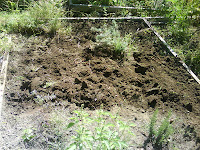
As I've written before, the garden seemed like a great idea, but in practice, it's been so-so at best (the photo to the right was actually taken on a good day). Having one of the less than a dozen garden plots (for 34 units), we've considered giving ours up for a while. But every spring we pledge that this will be "the year" for our garden.

A couple weeks ago, we finally gave it up. But it had nothing to do with the work involved.

This year, a fellow gardener had the thought that because our garden plots are situated on industrial-filled land, a soil test might be in order. The results showed the sporadic presence of heavy metals, including lead (we're still waiting on exact lead numbers).

My wife and I have always tried to eat organic (or at least locally grown) produce, especially since our daughter was born almost two years ago. So needless to say, those preliminary soil results led (no pun intended) us to give up.

Not having a garden should mean more family time and - of course - finishing home projects. I only wish we'd gotten the soil test results before I dug two-plus feet down in our plot so we could line it to keep the grass out.

Thursday, May 13, 2010

It's not that easy being green, part 1

When converting our building from a vacant shoe assembly plant to lofts, the forward-thinking developer installed a couple energy- and water-efficient technologies. In theory, this would seem like an excellent decision. In practice, however, each has provided more than their share of headaches. In part one of a two-part post, I'll talk about the first of these: The toilet.

We have a power-flush toilet, which uses air pressure to quickly (and loudly) drain the bowl, eliminating the need for excess water to be stored in the tank. The trouble started within
six months of move-in.

Part of it was my fault. Never having seen a power-flush before, I dropped a sanitizing tablet into the half-inch of water that accumulates under the flushing assembly. This actually caused the chain from the handle to the activator button to corrode and break. My wife was not amused when this happened while I was in Florida on business. Upon returning, I was able to fish the majority of the mostly undissolved tablet out of the tank and replace the chain.

The next headache was with the assembly itself. As a result of our water coming into the building through old pipes, the small amount of sediment it contains builds up over time and causes the stopper to stick in the open position. With this open, the system can't re-pressurize - and the toilet won't flush. Luckily, the sound of running water accompanies this, so I know when to fix it. While this is annoying, it's easy enough to take apart and clean.

The major problem is that I've taken that assembly apart so many times that at least four of the eight screws that hold the cap in place have stripped the plastic holes they fasten to. This also prevents re-pressurization and is more difficult to fix. To seal the tank, I put silicone around the rim of the cap (on top of the rubber O-ring) to hold it in place.

So far, my solution has worked (knock on wood), but I know it's only a stopgap. I've scoured the Internet for a more permanent fix, and so far, the only solution I've found is to use fatter screws. Having no other ideas, I'll try it.

So while our toilet is taking care of the Earth, it's certainly not taking care of us.

Next up: the wall-hung boiler.

Monday, May 3, 2010

"Daddy fix"

One of the drawbacks of being even slightly handy is that you build up expectations. In the past, my not-so-handy (or not-handy-at-all) friends and family have often called on me for advice or ask me to help them install or repair something (or even to do it for them). Partly because I like to get all the experience I can, and partly because I've always had trouble saying no, I usually oblige. Not surprisingly, it poses quite a quandary when it comes to my own projects.

While I enjoy helping, these requests have thankfully dried up in the two years since my daughter. People are respectful of the fact that I don't have the time I once did for my own projects - never mind theirs.

This segues perfectly into the new quandary of high expectations - my daughter's.

As she's gotten older, more independent and very, very smart, she's seen me fix a few things, including some of her toys and pop-up books that no longer pop up. I love seeing the expression on her face when she sees Elmo and his daddy back in their rightful place in one of her books. The Baby Einstein book "Jane's Animal Adventures" was a particularly tricky fix, but it's been restored to as close to its original form as humanly possible.

So now, whenever something breaks, she hands it to me and says, "Daddy fix." Flowers, bananas, books, toys - it doesn't make a difference. I love that she looks up to me as a Mr. Fix-It hero who can repair anything.

Aside from the fact that she often seems to break things on purpose with the thought that I'll fix them, the biggest problem is that sometimes Daddy can fix. Sometimes he can't. For example, you can mush a banana back together. But in the case of flowers, tissues or other un-fixables, if a reasonable facsimile can be found, a little sleight of hand usually does the trick.

So in addition to my continuing education in the ways of DIY and home improvement, I'm also getting a self-taught education in magic tricks.

But given how smart this one is proving to be, I have to wonder how long I can get away with that.

Monday, April 26, 2010

Kickin' it with home improvement

I saw a new Home Depot commercial on TV last night that implored viewers to "kick your excuses to the curb" and finally finish those home projects they've been meaning to get to (I'm paraphrasing; it was late).

That got me thinking about my excuses for not getting to the projects I have either in-progress or on THE LIST. What I came up with is: time, not having the right tools, inconvenience (tools and supplies live in my basement storage unit and I do all my cutting down there) and a lack of knowledge of exactly what I'm doing.

Of course, time is the biggest of these. I can deal with all the others, but without the time to commit to projects, nothing else matters. As I thought about time, that seemed too generic, so I've broke it down into segments: work, family (in general and watching my daughter during the day) and basic household chores.

So if I were to kick my excuses to the curb, I'd be unemployed and wolves would be raising my daughter. I think I'll just deal with my tortoise-like DIY pace.

Thursday, April 15, 2010

A "tired" old scam

Everything I know about car maintenance and repair I learned from my first car, an '83 VW Rabbit. It was a solid piece of automobile, complete with metal bumpers, that I overpaid for and constantly had to tweak just to keep it running. There was no fuel injection on that beast, so it's fair to say that aside from the basics, I know nothing about today's engines. And I know less about suspensions.

Not surprisingly, my wife knows very little. More surprisingly is that there are repair shops that didn't learn from all the hidden camera investigations that revealed mechanics attempting to persuade female customers they needed expensive (and completely unnecessary) repairs.

Am I making inaccurate, wild or irresponsible accusations? Judge for yourself after reading the facts.

A short time ago, my wife took one of our cars to a Northeast-based national chain that specializes in tires to get four new ones installed. (Rather than refer to them by name, I'll simply refer to them as Tire Giant to keep the lawyers away.) Through social media, Tire Giant provided us with a discount on the service, so it seemed like a great deal.

Once the car was in Tire Giant's possession, an employee told my wife that the tie rods and boots (among other things) were shot. Unless we spent more than $1,000 to repair them, Tire Giant wouldn't be able to perform an alignment. Nor could they guarantee their work. Being naturally suspicious of repair shops, and wanting to have the problem checked out by our regular garage (friends of the family), she declined the repairs. As you might imagine, the car drove very poorly without that alignment. Especially at high speeds, which, when someone commutes by highway an hour each way to and from work, is not only annoying, but downright dangerous.

Fast forward to our regular shop, where we took the car for an inspection. After performing a thorough examination of the vehicle as they usually do when we bring it in for any service, they not only issued an inspection sticker, but didn't see anything wrong with the items Tire Giant had mentioned. Unfortunately, this garage doesn't do alignments, so we had to find a new shop.

Yesterday, Don Foshay's Discount Tire in Biddeford performed the much-needed alignment - for $39.95. They had no trouble doing this with the supposedly "shot" tie rod et al, nor did they mention that those items needed to be replaced. How odd.

You may disagree, but from where I'm sitting, if one shop wants to perform $1,000+ worth of repairs, shouldn't another? I'd think so. But neither of the two other shops where we took our car did. And one of them was able to perform that "impossible" alignment without those repairs.

No wonder repair shops and mechanics get a bad name. All of this makes me wish I knew more about cars and could perform more work myself. Apparently, it's possible to do your own alignment, but while I love learning new skills, in matters of safety I'll leave that to the professionals.

Unless those professionals work for Tire Giant.

Monday, April 12, 2010

Extreme drywall repairs

As I mentioned in my last post, I like to keep any drywall repairs simple. My skills do go beyond a simple DAP Patch Stick, but I'd rather not use them for a lot of reasons. The mess of sanding being at the top of the list.

But there will come a time when I'll need to man up and go the distance, even if that means cutting old drywall out and replacing it with a new patch.

That's why I love Extreme How-To. It's one of the best DIY resources out there, and they are great at taking what could be a very difficult project and providing thorough step-by-step directions, like they've done with this article on repairing drywall.

After reading it, you'll understand why the magazine is called EXTREME How-To.

Friday, April 9, 2010

Toothpaste for grownups

Ever have to patch drywall? I have, and you know what? For the most part, it's not that hard to do.

The easiest I've ever used is to fill nail (or dart) holes with white toothpaste (ah, college). On a white wall, it can be almost impossible to notice. Do it the night before your landlord comes by for the final walk-through and you should get your security deposit back. Or at least if you don't, the nail holes won't be why.

As an adult male homeowner, toothpaste won't do. So for small-ish holes (i.e. 99 percent of what I've dealt with), I use a marvelous invention called the DAP Patch Stick. It's like the toothpaste trick, just more permanent and durable. And it's for grownups. At less than four bucks a stick, there's no excuse for not having one stowed in the garage or junk drawer. That goes for every household.

(As an aside, the last time I was at Home Depot, I noticed there's now a DAP Stick specifically for nail holes, which costs about a dollar more. Is it worth the difference? I'll let you judge for yourself. Personally, I'm reminded of the Simpsons episode where a company released a "new" version of the Malibu Stacy doll with the only change being that she had a different hat.)

The other grownup method I've used for repairing drywall is much more labor-intensive. Therefore I avoid it as much as possible. If the hole's too big for the DAP Stick (in my estimation, which tends to be much more liberal than DAP's), I have to get out the old drywall mud, slather some on, smooth it as much as possible, wait for it to dry and then sand it smooth. Luckily, I've only had to do this a few times - with varying results.

And most luckily of all, I've never had a hole big enough to require floating a new piece of drywall (knock on wood). That would require a house call/demo from dear old Dad.